

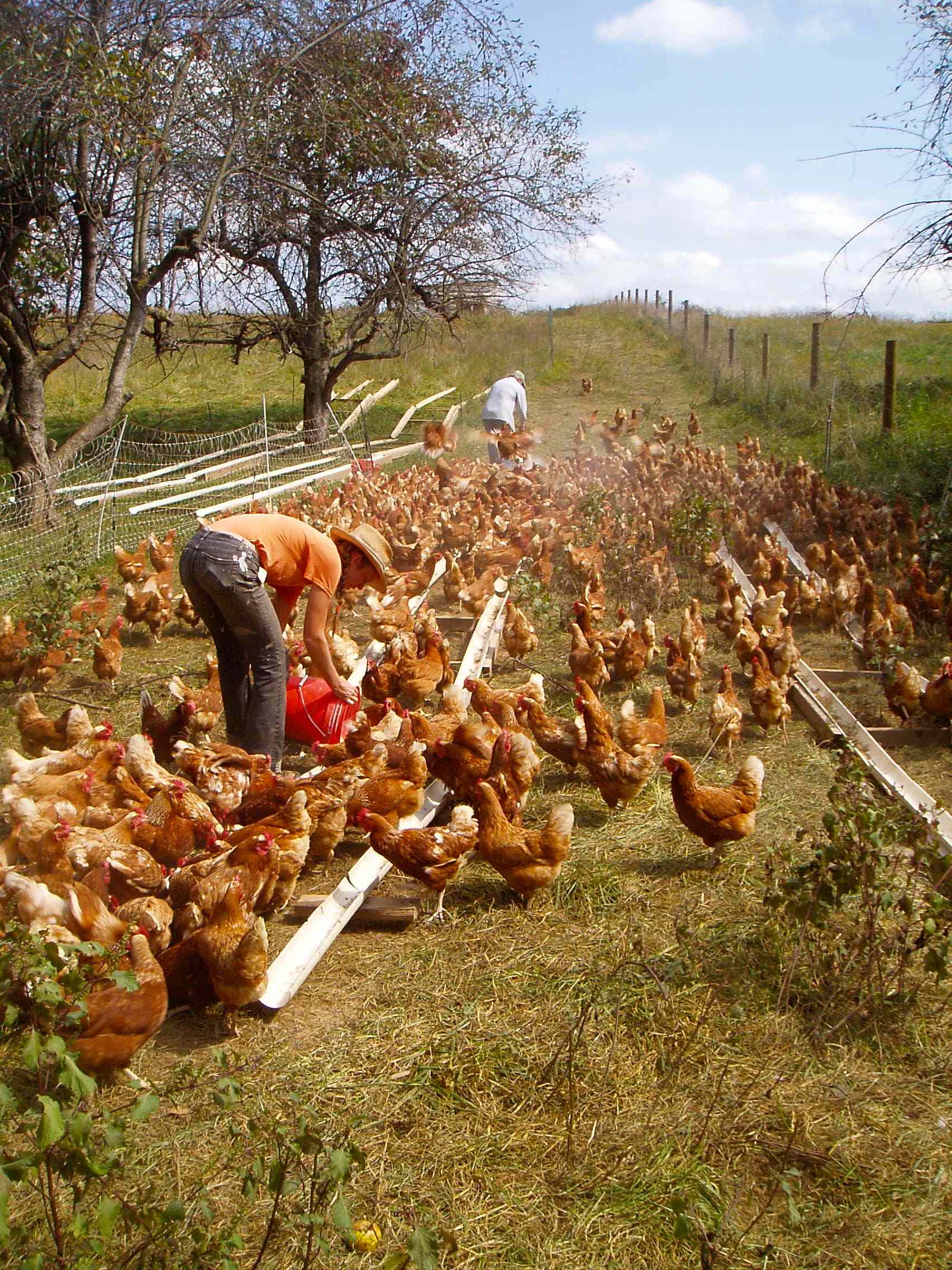

Feeding our flock of free-range laying hens on pasture. Note the poultry nets on either side of the run, keeping the chickens in, and foxes out.
I was raised in a chicken coop. Seriously.
Okay, okay… I didn’t literally grow up inside a chicken coop. I didn’t sleep there, or do my homework perched on a chicken roost. But I did spend a tremendous amount of time inside my grandmother’s hen house when I was a kid: gathering eggs, feeding the birds, and simply enjoying the passing parade of poultry. As a five year old, there were few places I’d have rather been than surrounded by a flock of happy, singing chickens.
There were only about twenty or thirty birds in all, but they produced more than enough eggs to feed our family. My grandmother used the extra eggs for baking, or sold them after church. We ate fried chicken on Sunday afternoons, and scrambled eggs for breakfast throughout the week. I never heard of a ‘chicken nugget’ until I was well into my teens.
Thirty years later, I found myself raising thousands of chickens on pasture each year, making a living on our family farm by selling free-range chicken and eggs at farmers markets. To many shoppers, the words ‘free-range’, ‘local’ and ‘organic’ can be, understandably, confusing terms. Let’s start with what ‘free-range chicken’ means on my farm:

Young meat chickens enjoying fresh pasture. Note the small doors cut into the side of the hutches. Having multiple doors allows us to create new alleys with our nets, providing fresh pasture for our foraging birds.
A free-range chicken is a bird that is allowed constant access to the outdoors, with plenty of fresh vegetation, sunshine and room to exercise. Moreover, it has not been given any chemicals (antibiotics, for example) of any kind.
Frequently, this type of production is called ‘pastured poultry,’ though models can vary significantly from one farm to another. To better clarify what a free-range chicken is, let’s discuss what it’s definitely not.
Two Very Different Types of Chicken
According to these USDA statistics, in 2010, the United States produced over 36 billion pounds of chicken. To put this number in perspective, this article by the University of Wisconsin Madison cites that even well into this century, only 12 U.S. producers could be identified who raised more than 4,000 free-range chickens a year. Extrapolating UWM’s math, that’s roughly 200,000 thousand pounds of free-range chicken, but only .05% of chicken being raised nationwide. Put another way, that’s a wafer-thin .0006 pound slice of free-range chicken per American citizen, per year.
Let me quickly say that I believe there are more than 12 producers raising flocks of over 4,000 free-range chickens nationwide. (To support this assertion, I personally know several farmers who raise more than 4,000 free-range chickens, who weren’t identified in the survey). But even if we triple or quadruple these numbers, we’re still not close to approaching 1% of the total number of chickens raised each year in the United States.

A happy chicken will lay about 270 eggs a year, or about 5 eggs per week. Our 900 hens are currently laying about 650 eggs a day.
Regardless of the statistics, the takeaway here is this: most chickens are not raised free-range. The vast majority of chickens raised in America are grown in confinement buildings, with feed, water and air piped in. These chickens never see sunshine, much less fresh grass. According to the USDA’s official standards, ‘free-range’ means little more than chickens having occasional access to the outside world. For many shoppers, this ambiguous definition creates a disconnect with what they believe free-range chicken to be, and what the reality truly is.
By now, you might have seen the Meatrix or read Fast Food Nation, so I won’t digress very far into how most chickens in America are raised. But if you’ve ever wondered why free-range chicken seems so “expensive,” simply take a trip to a confinement poultry operation to learn why factory farmed chicken is so “cheap.” The contrast between free-range and confinement chicken farms never fails to make an immediate impression.
Raising Free-Range Chickens Can Be… Challenging
You might be asking yourself, “if free-range chicken is really so great, then why aren’t more farmers raising them this way?” To start with, raising free-range chickens is more than just a job. It’s a way of life. Ever heard the expression ‘waking up with the chickens’? How about ‘the early bird gets the worm’? There’s a reason for these cliches: chickens rise well before dawn. They begin foraging at first light, and many of them have already laid an egg by the time most folks step into the office for the morning. If you want to be a free-range chicken farmer, you’d better enjoy getting up very early.
More importantly, unlike confinement chickens —protected inside buildings with automated lights and temperature controlled conditions— birds raised on pasture are incredibly vulnerable to all sorts of natural calamities. Unrelenting heat. Freezing wind and snow. A seemingly endless list of predators (foxes, hawks, raccoons, neighbor’s dogs, etc.). And because laying hens need about 16 hours of light each day to lay their best, even daylight can be a major factor. Still, when properly managed, raising birds this way ensures a life filled with fresh air, green grass, and beautiful sunshine. Who wouldn’t want that?
What I Learned From My Grandmother

Robert has one of our laying boxes open. The chickens access their nests from the inside, and we gather the eggs from the outside. Notice how green the grass is next to where they have recently grazed. The brown grass will now get 60 days of recovery time before the birds get that strip of pasture again.
Grandmother had it all figured out. Close the door to their coop at night, to protect the hens from chicken-eating varmints. Open them up first thing in the morning, so they get the tastiest bugs. Keep them nearby, so you’ll always know what they’re up to. And have a fat farm dog on the porch, as a deterrent to daytime predators that might be passing through.
Feed them a little chicken feed, but not so much that they stop foraging. Give them access to plenty of fresh air and exercise. Keep the bedding in the coop clean and airy. And always keep fresh, green vegetation in front of them.
When I first decided to raise free-range chickens (both meat birds as well as egg layers), each of these aspects were major challenges. How would I protect the chickens from foxes and hawks? How would I ensure they had fresh grass year round? Could I protect them from wind and rain, while providing 24 hour access for free-ranging? I put together this video to explain how 15 years of free-range experimentation finally came together:
To further illustrate how we do things, here are a couple of simple drawings. Imagine that the free-range system is like hands on a clock. Every couple of days, the minute hand ticks forward one click, giving the chickens a fresh swath of pasture. The ‘soiled’ pasture behind them is now allowed 60 days of recovery. As the video explains, this is accomplished by moving an electrified net that keeps the chickens in, and the predators out.

 The Bottom Line: Get To Know Your Farmer
Free-range chicken really does exist. But like most good things in life, finding the source often requires a little legwork. While chickens labeled ‘free-range’ or ‘organic’ at the grocery store are probably raised as advertised, there’s simply no substitute for getting to know your free-range farmer in person. Unless these supermarket chickens come from a farm that you can actually visit (and see the birds in person), I recommend doing a little more research before actually buying one. Knowledge is power.
Want to raise your own chickens? Check out my books below, where I take you through the entire process!
| Gaining Ground | Growing Tomorrow | Start Your Farm |
|---|---|---|
  |
  |
  |







Leave a Reply